I help nonprofits clean up their CRM, fix reports that don't add up, and get data from different systems working together, so staff spend less time fixing spreadsheets and more time on the mission.
Start with sample data, or list your own columns and get realistic fake data in that shape. Pick the charts you'd want every month, filter them, then generate a build spec. No real records needed.
Tip: click ⚙ on any card to change the chart, measure or grouping.
Nothing you do here is saved or sent. The playground runs entirely in your browser with made-up data, and it's gone when you close the tab. This site has no cookies, no analytics and no database.
Project questionnaire
Tell me what you're working with.
Ten minutes of answers here saves an hour on the first call. Skip anything you're unsure about. If you built a mockup above, it comes along automatically.
Thanks. Here's what you're sending.
Review your answers, then send them by email or copy them into a message.
Most nonprofits don't need a new system. They need the one they have set up right, cleaned up, and reporting numbers people believe.
01
CRM audits
A clear look at how your CRM is set up and used, what's causing problems, and a prioritized plan to fix it.
02
Data cleanup
Duplicate records, household confusion, blank and inconsistent fields, with clear rules so it stays clean after I leave.
03
Reports and dashboards
Power BI dashboards and CRM reports that answer real questions, validated against the raw data before anyone relies on them.
04
Data pipelines and integration
ETL pipelines that bring several systems into one place, match the same person across them, and keep history, without creating new duplicates.
05
Grant and KPI tracking
Simple ways for program staff to report outcomes, scored automatically so you always know which contracts are on track.
06
Evaluation plans and outcome reports
Logic models, indicators and outcome reports that show funders what your programs achieve, built from data you already collect.
07
Training and guides
Plain-language guides and trainings so your team can run reports and keep data clean on their own.
SalesforceApricot by BonterraWellSkyClarity HMISDynamics 365Power BISAP BusinessObjectsMicrosoft FabricPythonExcel and SharePoint
Where most clients start
The Data Health Check
A fixed-price review of your CRM or database. You'll know exactly what's wrong, why it's happening, and what to fix first, before you spend money on a bigger project or a new system.
Data quality scanDuplicates, blanks, and inconsistent values, with counts so you can see the size of the problem.
Setup reviewFields, record types, households versus individuals, permissions, and how data gets entered.
Report checkYour key reports tested against the raw data, so you know which numbers to trust.
Prioritized action planWhat to fix first, what it takes, and what your team can handle without outside help.
Packages
Fixed prices, sized for nonprofit budgets.
Every package has a clear price and scope, so there are no surprise invoices. Not sure which fits? The questionnaire and a free call will sort it out.
Always free
30-minute intro call
We talk through what's going on with your data, and I recommend a package, or tell you honestly if you don't need one. No screen-sharing, no homework, no pitch.
One 75-minute working session · within 1 to 2 weeks
Screen-share walkthrough of your CRM or spreadsheet
Your biggest data problems, named
Written summary with your top 5 fixes
Fee credited toward a Health Check within 30 days
Most popular
Data Health Check
$600
About 3 to 4 weeks
Duplicate and blank-field scan with counts
Setup review: fields, households, permissions
Key reports tested against the raw data
Prioritized action plan and a 45-minute walkthrough
Fix it
Cleanup Sprint
from $900
About 5 to 6 weeks · quoted by record count
Rules for which duplicate record survives
Duplicate merge and standardized fields
Validation rules so it stays clean
Before and after report for your board
See it
Dashboard Starter
$1,200
About 6 to 8 weeks
Power BI or CRM dashboard from one data source
Up to 8 visuals plus a data quality page
Site or program security if needed
One revision round, a guide and a training session
Keep it running
Monthly Support
$350/month
5 hours a month · replies within 2 business days · cancel anytime
Report fixes and new reports
Monthly data quality check
Staff questions answered by email
Extra hours at the hourly rate
Everything else
Hourly work
$65/hour
For small jobs that don't fit a package
One-hour minimum, then billed in 15-minute steps. Hours are estimated before any job starts.
Small nonprofits: 15% off any package if your annual budget is under $500K
Founding clients: 25% off for my first three nonprofit clients, in exchange for an honest testimonial
Discounts don't stack and don't apply to intro prices. Software and licenses aren't included.
Program evaluation
Show funders and your board what your programs achieve, using the data you already collect.
For grant season
Grant Evaluation Section
$450
About 2 weeks · book 3 or more weeks before your deadline
The evaluation section of one grant proposal
Outcomes, indicators and how you'll measure them
Matched to the funder's own requirements
Plan it
Evaluation Plan
$900
About 4 to 5 weeks
A logic model linking activities to outcomes
The indicators to track and where each number comes from
A simple data collection plan your staff can follow
Reusable across grant applications
Show results
Outcome Report
from $2,200
About 8 to 12 weeks · up to $3,000 depending on data sources
Analysis of your existing data against your goals
Clear charts and a 6 to 10 page report
A one-page summary for funders or your board
A walkthrough of the findings with your team
When I work: I take on projects outside regular business hours, in the early mornings, evenings and on weekends, Pacific time. Calls can be 5:00 to 7:30 a.m. Pacific (8:00 to 10:30 a.m. Eastern) or after 6 p.m. Timelines above reflect that schedule and start once I have access to your data. I take on one larger project at a time, so each one gets my full attention. Evaluations here use the data you already collect; I don't run interviews, focus groups or research studies.
Selected work
Case studies
Real projects from multi-site social services work. The write-ups leave out client data and names, and the ETL code runs on invented data so anyone can try it.
Power BI · DAX · Power Query
Multi-site KPI compliance reporting
A monthly view of contract performance across 65 sites, built from protected Excel workbooks that site staff fill in. Each site leader sees only their own site.
One view of each client across Salesforce and HMIS
A medallion ETL pipeline that brings case management and county HMIS records into one warehouse, finds people who appear in more than one system, and counts them once.
A monthly view of contract performance across 65 sites, built in Power BI from data that site staff enter in protected Excel workbooks.
Organization
Regional division of a large national nonprofit running social services programs
My role
Built the data entry design, pipeline, model and dashboard
Scale
About 1,200 KPIs, 170 site-program contracts, 65 site workbooks
Tools
Power BI, DAX, Power Query, Excel, SharePoint
The situation
The division reports to dozens of funders, and every contract has its own performance and compliance terms. Leadership wanted to know, month by month, which sites were meeting them. There was no single place to look. The KPIs came in different shapes (counts toward an annual goal, monthly rates, yes-or-no compliance terms), the people entering data were site staff rather than analysts, and the master KPI list had trailing spaces, duplicate spellings and mislabeled types that could quietly break a score.
What I built
Site entry workbooks: one protected Excel file per site, a tab per contract, validation by KPI type, and a KEY tab with worked examples.
Ingestion pipeline: Power Query combines every tab into one table and lists the sites and contracts that haven't submitted.
Scoring model: a DAX library that scores each KPI by type, tracks year-to-date pace, red-flag streaks and contract end dates.
Secured reporting: row-level security so site leaders see only their site, across five report pages.
Getting the numbers right
24 KPIs labeled Point-in-Time were really cohort rates, so they had the wrong entry rules and scores. Reclassified in every workbook.
20 annual goals stored the cohort size instead of the percentage. Corrected, with validation to match.
The pace measure flagged sites as behind early in the year. Rewrote it as the correct share of the year to date.
A common DAX pattern dropped real zeros from scores. Switched the whole measure library to one that keeps them.
Outcome
~1,200contract KPIs scored monthly
65site workbooks on one template
44KPI and goal errors fixed
The division now has one view of contract performance, refreshed from site submissions each month, with missing reports and expiring contracts flagged. Next, the master KPI list is planned to move into a SharePoint List with permanent IDs and change history.
A library of ready-to-run Web Intelligence reports that directors, QA and program managers refresh on their own, built around an older platform and a data model that makes the obvious formulas wrong.
Organization
Regional division of a large national nonprofit running social services programs
My role
Built the queries, variables, layouts and staff guides
Scale
Seven saved reports on the live WellSky production database
Tools
WellSky, SAP BusinessObjects Web Intelligence, Excel, Python
The situation
Program and QA teams asked the same questions every month: who did we serve, how many households, are case notes going in on time. Each answer meant a custom query or a hand-built export. The reporting version in use has no distinct count, the data model repeats rows as soon as clients and households are joined, and there's no warehouse, so every report reads live production data.
What I built
Case management KPIs: caseloads, enrollments, exits, goal completion and note timeliness by site and staff.
Data checks: service code mismatches, missing birth dates or gender, households recorded without an adult, and data gaps by program.
Case note compliance: 3-day and 30-day entry thresholds, stale-note flags and entry lag.
Food pantry and service distribution: singles versus households, counted once and in total, with household size, ZIP and county.
Working around the platform
No distinct count: counted each ID once with a context-based formula, checked against a raw export.
Household joins repeat rows: classified households from the service-level field instead.
Duplicate client records: removed before counting so each client counts once.
Exit dates that can't be matched to the right enrollment: left out rather than showing a guess.
Outcome
7saved reports staff refresh themselves
9platform workarounds documented
2staff guides written
Staff get answers by refreshing a saved report instead of waiting on a custom pull. The food pantry matrix matched its raw export to within one known edge case. Still in progress: one consolidated error-check report, and a requested redesign of the reporting data model.
A Microsoft Fabric data platform that brings client, enrollment and service records from Salesforce and county Clarity HMIS instances into one warehouse, links the people who appear in more than one system, and keeps full history so reports count each person once.
Setting
Multi-program social services agency with several case management systems
My role
Designed and built the pipeline, warehouse, matching and tests
Status
Runs end to end on synthetic data in a public demo; production rollout in progress
Tools
Microsoft Fabric, PySpark, Delta Lake, T-SQL, Splink, DuckDB
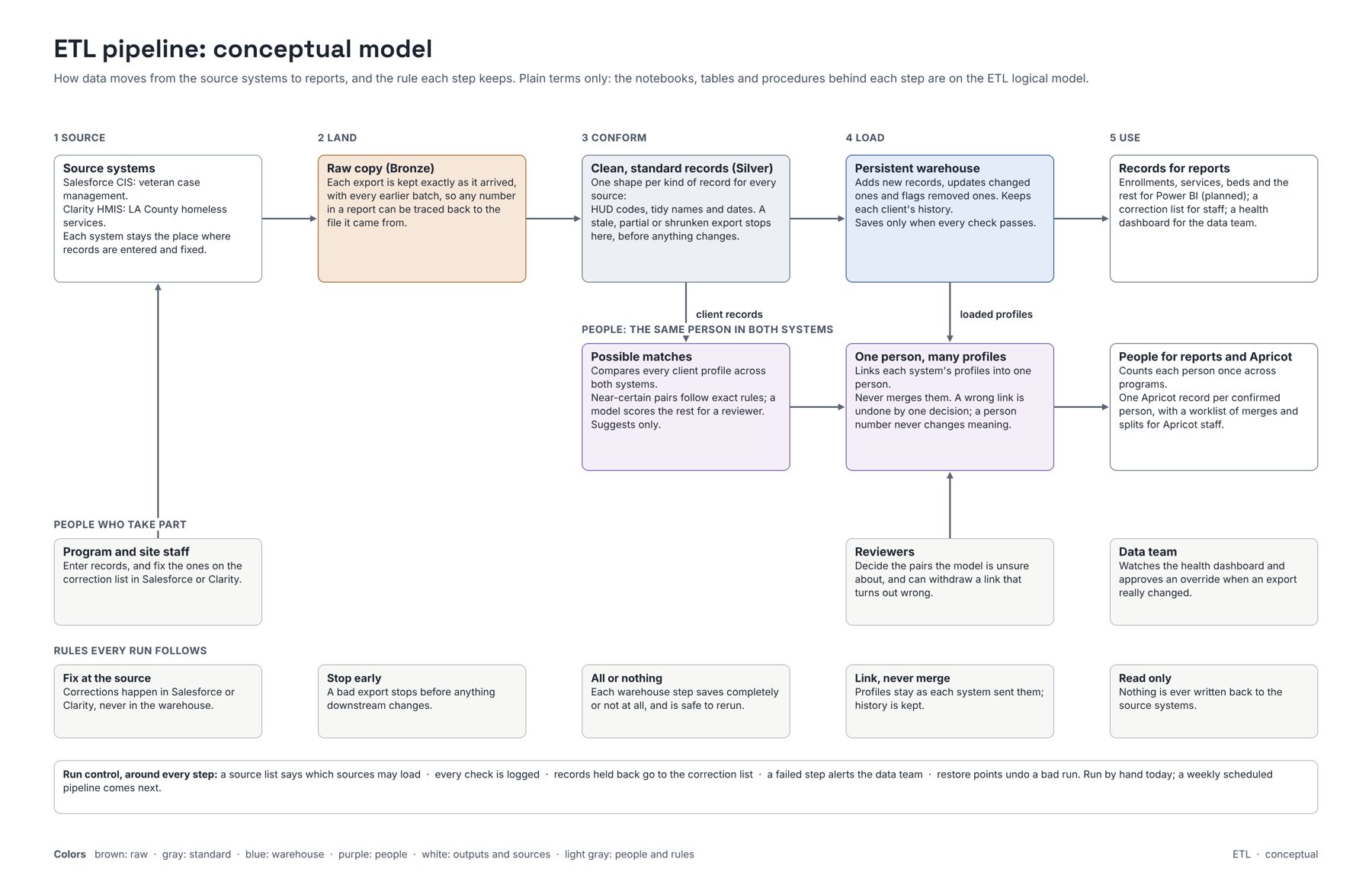
How data moves from the source systems to reports, and the rule each step keeps.
The situation
The same person can be a Salesforce contact and a client in more than one county's HMIS. Without a shared ID, funder outcome measures count them more than once, and nobody can see a person's full history across programs.
What I built
Bronze, Silver, Warehouse: every export kept exactly as it arrived, then standardized, then loaded into a persistent warehouse that keeps each client's history.
Quality gates: a stale, partial or shrunken export stops before anything downstream changes, and records that can't load go to a plain-language correction list for staff.
Record linkage with a reviewer: exact rules plus a probabilistic model suggest matches, and a person decides the uncertain ones.
Link, never merge: source records stay as each system sent them, so a wrong link is undone with one decision.
Privacy by design: the full SSN lives in one restricted table, matching uses throwaway tokens, and sensitive columns are masked from report roles.
Results from the demo run
947people found in 1,002 profiles
55/55suggested links correct, 55 of 58 true pairs found
255key checks, 0 problems
A second week of exports with edits, exits, deletions and a source-system merge loads cleanly, and rerunning a week changes nothing. The two missed pairs are a one-letter typo in a short surname with no ZIP code, a deliberate trade-off: a missed link waits for a reviewer, but a wrong link would merge two people's records.
The public repository uses invented people, programs and IDs. The code is the real pipeline, runnable locally in about two minutes.
How I work
Fix it at the source, then hand it back.
01
Listen
A free call to understand what's frustrating your team and what "fixed" looks like to you.
02
Audit
I dig into the data and the setup to find what's broken and, more importantly, why.
03
Fix
Changes go in at the source, tested against real data, so the same problem doesn't come back.
04
Hand off
Clear guides and a short training so your team can keep things running without me.
EGLong Beach, California
About
Hi, I'm Elmarthy.
I've spent my career in nonprofit data and compliance. Today I manage data systems for a large social services nonprofit across nine counties, where nearly every county runs a different setup. I build the reports, dashboards and KPI tracking leadership uses, clean up the data underneath them, and train the staff who enter it.
Before that, I built a case management module in Dynamics 365 with a Salesforce integration for a community health nonprofit, and a Python ETL pipeline that cut report prep time roughly in half for a homeless services agency. I'm now building a Microsoft Fabric warehouse that links the same person across Salesforce and county HMIS systems. I started Gallant Data to bring the same care to smaller nonprofits that don't have a data person on staff.
B.S. Public Health ScienceUniversity of California, Irvine
IBM Data EngineeringProfessional Certificate
Social services focusHousing, homelessness, community health
Remote-firstBased in Long Beach, working with teams anywhere
Let's talk
Not sure where your data problems start?
That's what the first call is for. Tell me a little about your organization and what's not working, and I'll reply within two business days to set up a free 30-minute call.
No sales pitch. If I'm not the right fit, I'll tell you and point you somewhere better. Calls are early mornings (5:00 to 7:30 a.m. Pacific) or evenings after 6 p.m.
Privacy: no cookies, analytics or tracking. The playground never leaves your browser. Questionnaire answers reach me only when you send them. Your light or dark choice is remembered on your device.
 Gallant Data